Semen analysis after a vasectomy
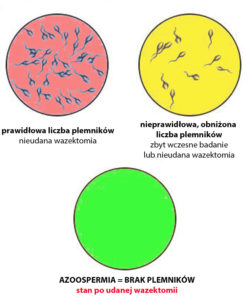
Semen analysis after a vasectomy performed in Katowice is intended to check whether sperm are still present in the ejaculate. This is not a classic semen analysis, in which sperm motility, morphology or quality are assessed – we are interested solely in their presence or absence.
If we find in the sample even immotile sperm in a number exceeding 100 thousand per millilitre, the patient is referred for a repeat test. The presence of motile sperm 6 months after the procedure, in turn, means that the vasectomy was ineffective and will have to be repeated.
In most No Scalpel Vasectomy (NSV) methods the risk of so-called recanalisation, that is the spontaneous restoration of patency of the vas deferens, ranges from 5 to 9%. This means that even every 12th patient needs the procedure to be performed again.
At our Katowice ZdrOva practice we use the proven Canadian method, which combines thermal coagulation with bringing the open end of the vas deferens outside the sheath of the spermatic cord. This technique reduces the risk of failure to a minimum – statistically to a level of 0-0.5%, and in our practice it is less than 0.06%.
Possible results of a semen analysis after a vasectomy
- A normal number of sperm present – this means a failed vasectomy, requiring the procedure to be repeated.
- A reduced number of sperm:
- the test was carried out too early (sperm may be present for up to 90 days after the procedure, being stored among others in the prostate and the seminal vesicles), or
- the vasectomy was ineffective.
- AZOOSPERMIA – the complete absence of sperm. This is the result confirming the effectiveness of the procedure.
- ≤ 100 000 immotile sperm in 1 cm3 – also regarded as a state after a successful vasectomy.
For comparison – the WHO norm for a fertile man is at least 15 million sperm in 1 cm3. 100 thousand is as much as 150 times less. Such sperm, if immotile, are old and come from the stores (e.g. the prostate, the seminal vesicles) – they are not capable of fertilisation.